
How Accurate Is an AI Resume Checker? An Honest Look at What the Score Really Means
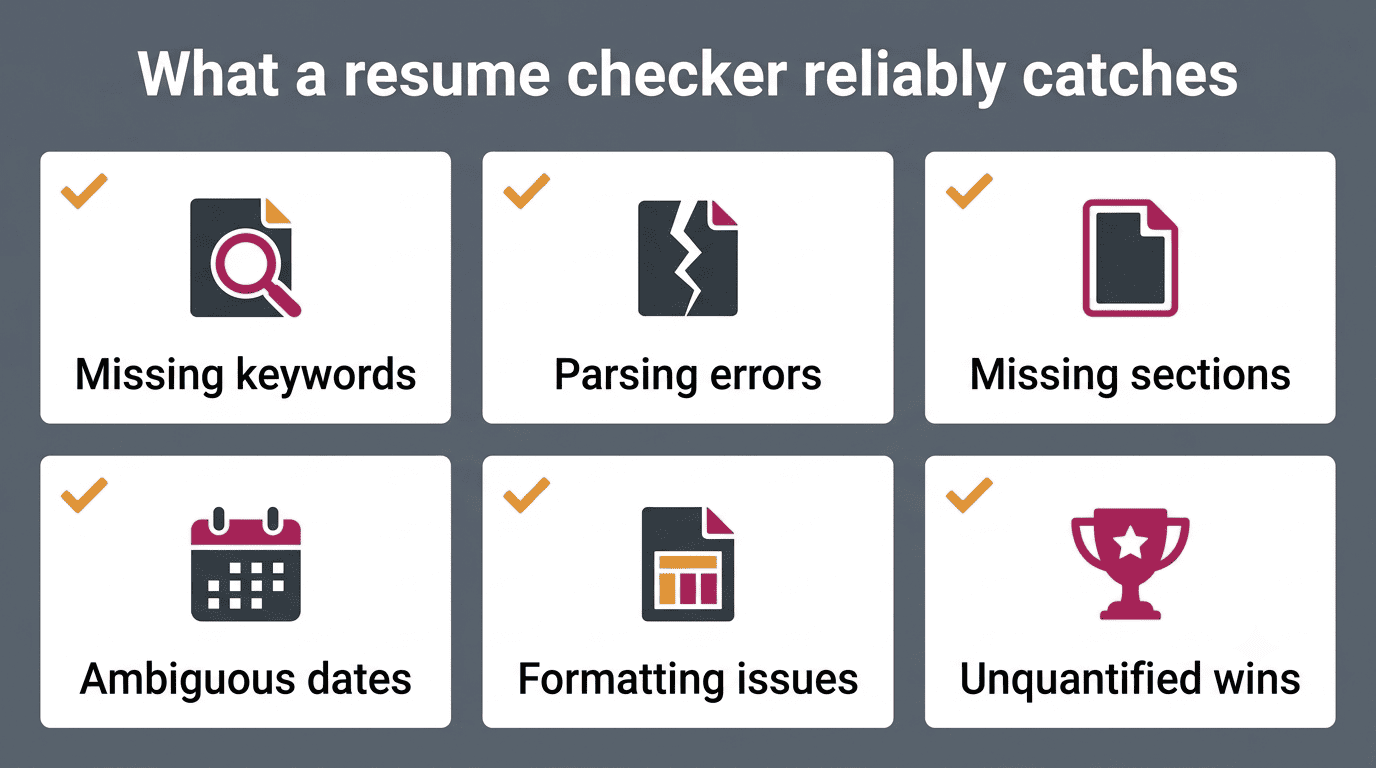
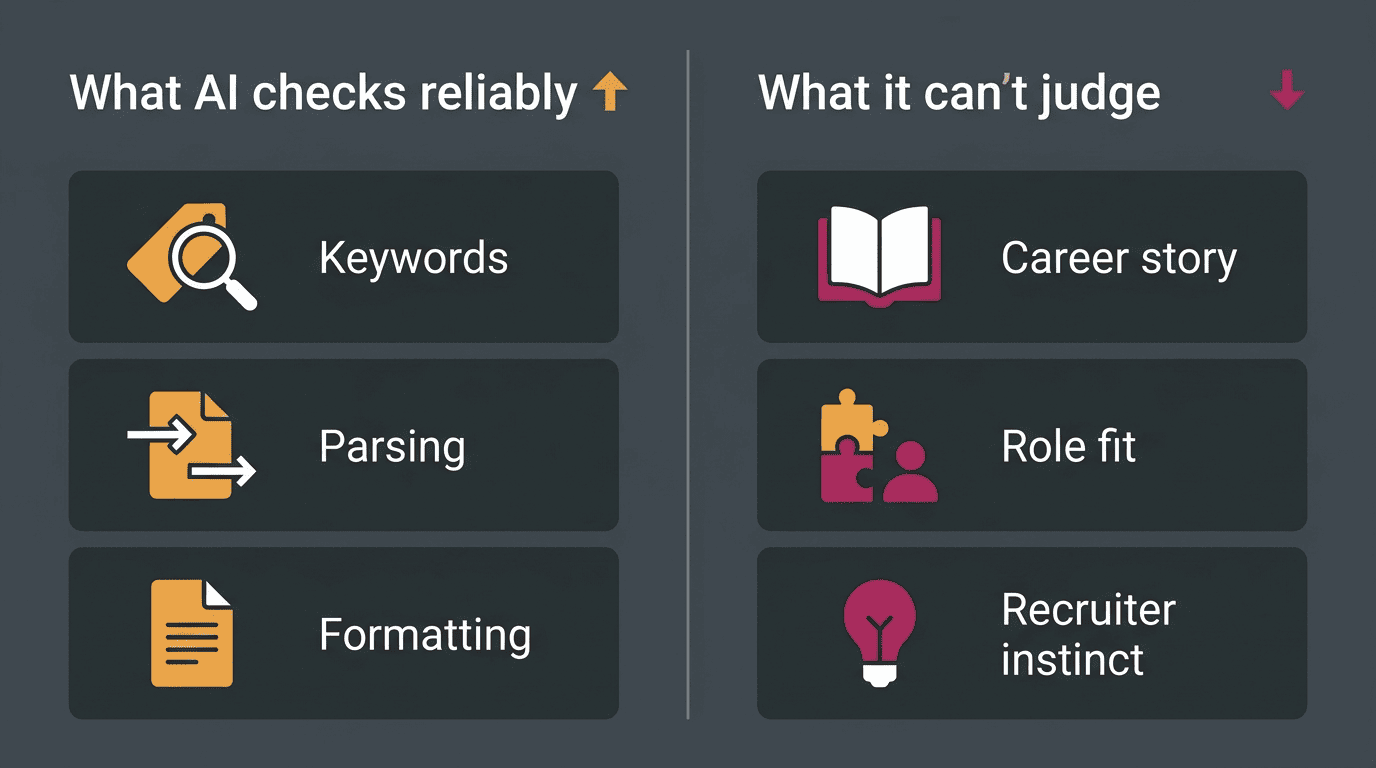
Accuracy depends entirely on what’s being measured. An AI resume checker reliably catches mechanical problems — parsing errors, missing keywords, formatting issues — the exact things software known as an Applicant Tracking System screens for, but it’s far less dependable at judging career narrative or role fit.

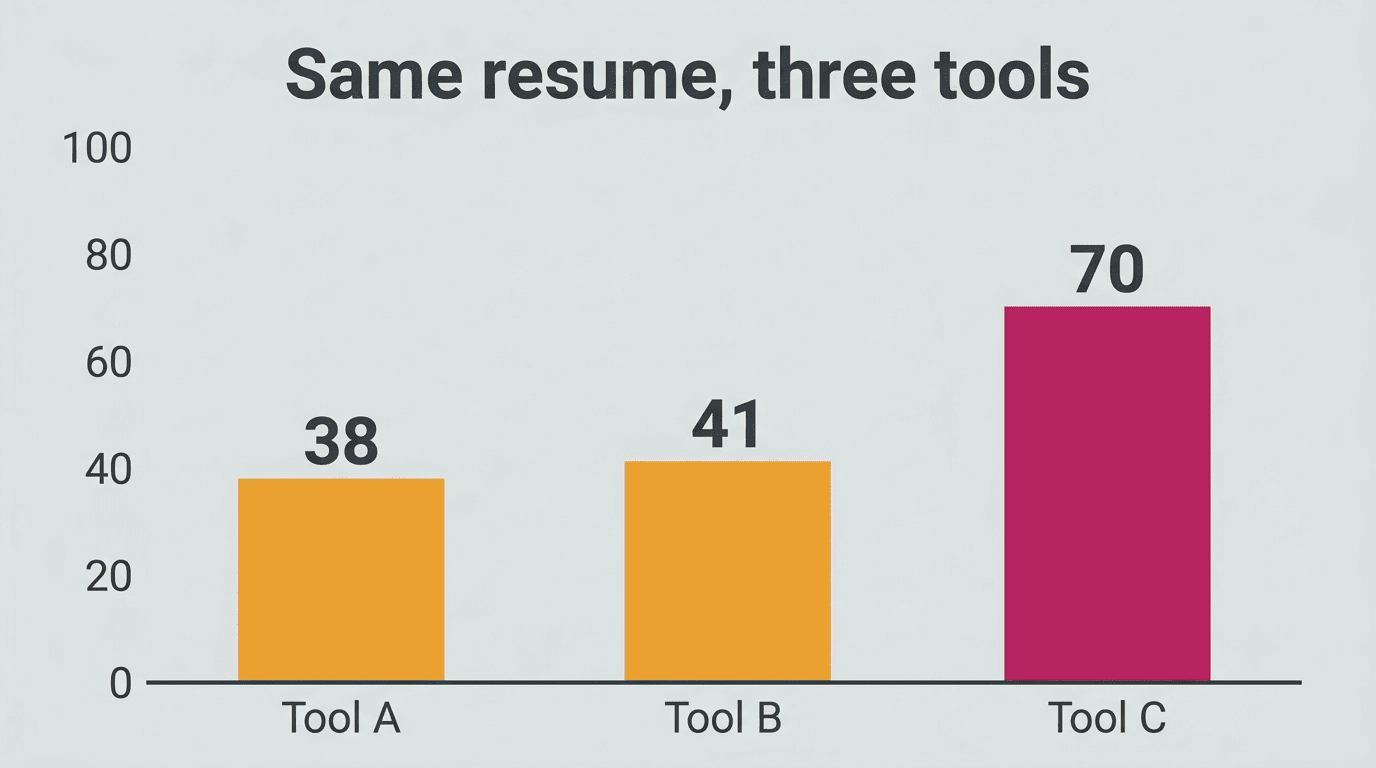
In one documented comparison, the same resume scored 38% on one checker, 41% on another, and 70% on a third — a 32-point spread that shows exactly why the raw number deserves scrutiny rather than blind trust.
Short answer: how accurate are AI resume checkers?
The honest one-liner
Accuracy is high for mechanical checks and low for qualitative judgment. A resume scanner reliably flags parsing problems, missing keywords from the job description, absent sections, and formatting issues — the things that get a resume filtered out before a human ever sees it. It does not evaluate the strength of a career narrative, how well a candidate fits a role, or the instinct a recruiter brings to a stack of applications.
Why there’s no single accuracy number
There isn’t one universal «accuracy» figure because different tools measure different things. In one documented comparison, one resume scored 38%, 41%, and 70% across three separate checkers — a 32-point gap on the exact same document. The number is a relative signal from a specific tool’s rubric, not a portable, universal grade — a stand-in for the category of hiring software an AI resume checker tries to approximate, not a readout from it.
| What the tool checks | Reliability |
|---|---|
| Keyword matching against a job description | High |
| Parsing (sections, dates, contact info) | High |
| Formatting issues (columns, tables, graphics) | High |
| Career narrative and story strength | Low |
| Role fit and seniority judgment | Low |
| «Recruiter gut feeling» | Not measured |
Why the same resume gets different scores
Different engines, different rubrics
Some tools compare a resume against one specific job posting — job-description matching — and those tend to track ATS behavior more closely. Others run a generic rubric and hand back a score «in a vacuum,» disconnected from any real posting. In a test of roughly 1,000 resumes run between February and May 2026, only 3 of 8 tools actually ran a genuine ATS-style parser under the hood; the catch rate for real parsing errors ranged from 88-97% among the strong performers down to just 14-58% among the weak ones.
Different number of checks
resume.io runs around 16 checks. Enhancv runs 27 checks across seven categories. Resume Worded runs 30 to 40-plus. More checks don’t automatically mean more accuracy, but the difference explains a lot of the score variance between tools. The scoring scales differ too, which makes a raw number meaningless without knowing which scale produced it:
| Tool | Approx. checks | Scale / «good» threshold |
|---|---|---|
| resume.io | 16 | Tiered: 80%+, 60%, 40% |
| Enhancv | 27 (7 categories) | 0-100 |
| Resume Worded | 30-40+ | 0-100: 85-89 «Strong,» 90+ «Exceptional» |
| Resume Optimizer Pro | Parser + keyword match | 85%+ «Strong,» under 65% usually filtered |
Here’s a quick way to sanity-check any score you get back:
- Check whether the tool asked for a specific job description before scoring — if not, treat the number as a generic rubric result, not an ATS prediction.
- Look at how many discrete checks the tool ran (often shown in a breakdown) rather than the single headline percentage.
- Compare the sub-scores, not just the total — a low keyword sub-score with a high formatting sub-score points to a different fix than the reverse.
- Re-run the same resume on a second tool if the first score feels off, and treat any spread under roughly 10 points as noise.
- Fix the specific flags the tool lists, not the number itself, then re-scan to confirm the flag cleared.
What AI resume checkers get right
The mechanical layer — high reliability
An AI resume checker is strongest exactly where most resumes get eliminated. Harvard Business School and Accenture’s Hidden Workers research found that 88% of employers admit their applicant tracking system routinely filters out qualified candidates — often on parsing errors and keyword mismatches that have nothing to do with capability — and that mechanical filtering layer is precisely what a resume scanner checks reliably:
- Keyword density against the target job
- Parsing failures (unreadable headers, contact blocks, tables)
- Missing or mislabeled sections
- Thin or unquantified achievements
- Ambiguous date formats
Harvard Business School’s Hidden Workers: Untapped Talent report documents how ATS filtering routinely screens out qualified candidates on criteria that have nothing to do with actual capability — the exact failure mode a resume checker is built to catch before it costs an applicant an interview.
Keyword and job-description matching
The most accurate function any of these tools offers is a direct comparison against a specific job posting. It shows exactly which required terms from the job description are missing from the resume. This is the most useful — and the most independently verifiable — part of the whole exercise, since a reader can manually check the flagged keywords against the posting in seconds. Run against the right job posting, a resume checker online turns a vague sense of «something’s off» into a specific, fixable list of missing terms.
Where AI resume checkers fall short
Judgement, narrative, and fit
A human reviewer is still better at judging career narrative, role fit, industry tone, and red flags like frequent job-hopping. An AI resume checker doesn’t «understand» a story — it counts overlaps between two documents, not the persuasiveness of the story those documents tell. This is also where hiring regulation enters the picture: the EEOC’s own initiative on artificial intelligence and algorithmic fairness addresses exactly this gap, flagging that automated screening tools can produce discriminatory outcomes when they substitute for human judgment rather than supporting it.
The over-optimization trap
Chasing the number instead of the fit backfires. Blind keyword stuffing can push a score higher while making the resume read worse to an actual person. Around 49% of hiring managers say they reject resumes that read as obviously AI-generated. The score is a diagnostic tool, not the goal itself, and treating it as the goal produces exactly the kind of resume that a real recruiter discards on sight.
Are ATS scores real? The myth to unlearn
The score is a simulation, not a readout
Real applicant tracking systems — Workday, Greenhouse, Lever, Taleo, iCIMS — do not hand a candidate a numerical «ATS score.» The number an AI resume checker shows is a simulation trained on typical parser behavior, not a value pulled from the employer’s actual system.
There’s no such thing as an ATS score—no tool online that provides a score gives an actual score.
Enhancv
So is the score useless? No.
The simulation is still useful as a relative before/after marker. If edits raise the score because of genuine keyword alignment and cleaner parsing, the resume has become objectively easier to process by real ATS software. The score only becomes harmful once it turns into a goal in itself rather than a diagnostic.
AI content detectors on resumes: a separate accuracy problem
Detection is probabilistic
A separate category of tool detects AI-generated text inside a resume rather than scoring ATS compatibility. These detectors return a probability, not a fact — best described as «estimates, not certainty.» Common benchmarks break the probability score into three bands:
- Under 30% AI-probability: treated as a safe target
- 30-50%: worth a second look, not automatically a problem
- Above 50%: flagged as high risk and usually worth rewriting
False positives are common: text a person wrote entirely by hand can still get flagged as AI-generated, so a single detector reading should never be treated as conclusive.
How to use an AI resume checker accurately
The 70/30 workflow
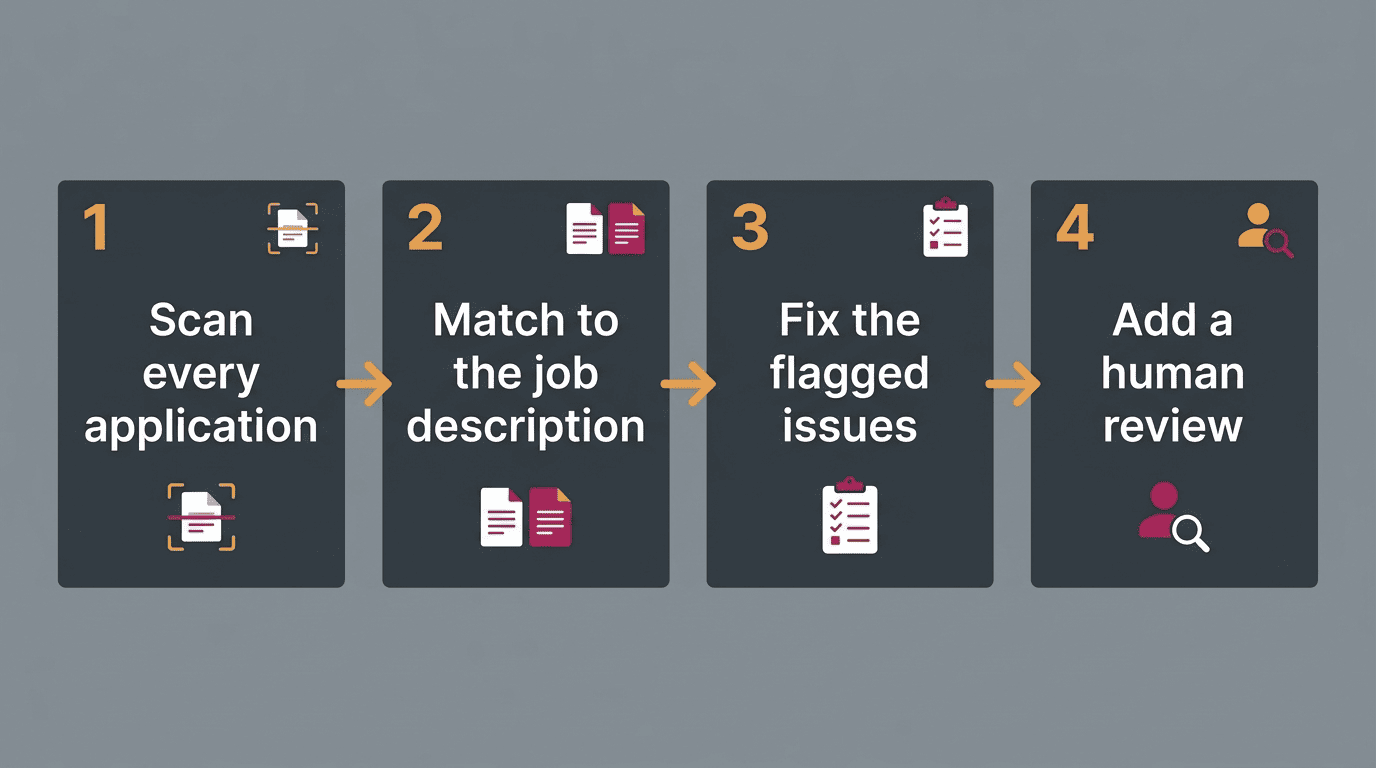
Run an AI resume checker on every application — it’s free, fast, and catches mechanical issues immediately — and match it against the specific job posting each time. Add a human review roughly once a quarter, or before a senior-level application, where the narrative matters more than keyword overlap. The split holds up well in practice:
- Every application: AI checker against the specific job description
- Quarterly, or before a senior-level role: human review for narrative, tone, and fit
That covers the mechanical 70% of the work reliably; the remaining 30% still needs a person.
Read the score as a to-do list, not a grade
Don’t chase the number itself. Look at the specific flags — a missing keyword, an ambiguous date format, a skills section the parser can’t read — and fix those individually. The score rises as a byproduct of fixing real problems, not the other way around. Used this way, an AI resume review becomes a checklist, not a verdict on the candidate. Worth saying plainly: a high score improves the odds a resume reaches a human reviewer — it assists the search, it does not guarantee an interview or a job offer.