
Free AI Resume Checker: What You Get for $0 (and What You Don’t)
Uploading a resume to a free scoring tool before you apply is now a normal first step in a job search, not an extra one. A free AI resume checker reads the file, scores it the way hiring software would, and hands back a match rate plus a list of fixes — without asking for a credit card. Most mid-size and large employers now run resumes through some form of an Applicant Tracking System before a human ever opens the file, which is exactly why that free score is worth having. This guide covers what the free tier actually gives you, whether the results are accurate, whether it’s safe to upload your resume, and how to use one well.
Short answer: yes, genuinely free checkers exist, and some run without any signup. But «free» has edges — the deepest, line-by-line feedback and unlimited scans usually sit behind a paywall, so the trick is knowing what to expect before you upload.

What a free AI resume checker actually does
A free AI resume checker parses your uploaded file (PDF, DOC or DOCX), simulates how an Applicant Tracking System would read it, and returns a 0-100 ATS score with the specific issues it found. It isn’t a spellchecker with a new coat of paint — it’s built to catch the things that make a resume invisible to hiring software:
- Missing hard-skill and soft-skill keywords
- Weak or unquantified impact statements
- Layouts and tables that break ATS parsing
- Inconsistent or non-standard section headings
- File formats the parser can’t read cleanly
From upload to score in seconds
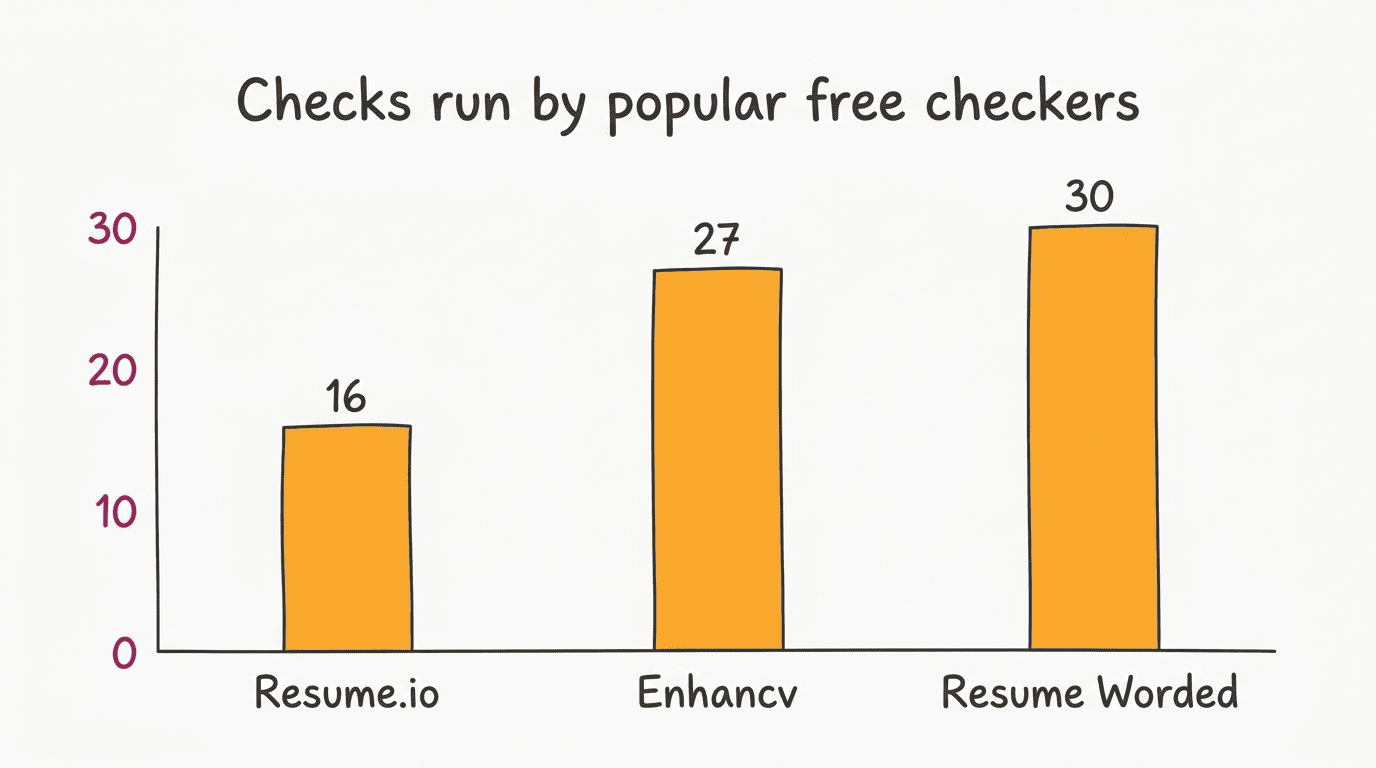
Free checkers vary in depth but follow the same basic loop. Resume.io runs 16 essential checks, Enhancv runs 27 checks across seven categories, and Resume Worded runs 30-plus checks that adjust to your career level. All three return the score within seconds of upload, alongside a ranked list of what’s dragging the number down — usually formatting first, then keyword gaps, then weaker content issues like vague bullet points.
| Free checker | Checks run | Signup needed |
|---|---|---|
| Resume.io | 16 essential checks | No |
| Enhancv | 27 checks, 7 categories | No |
| Resume Worded | 30+ adaptive checks | Yes |
The speed is the point. Where a human review takes days to schedule and depends on someone’s calendar, a free checker gives you a same-minute read on where your resume stands, so you can fix the obvious problems before you ever submit an application.
What’s under the hood
These tools aren’t guessing at what «good» looks like. Enhancv’s checker runs on ChatGPT plus pattern data drawn from resumes at scale; Resume Worded says its feedback engine was designed by recruiters with experience at major employers. That’s the difference between a free ATS resume checker and a plain word-count tool — the former catches things a spellchecker never would, like missing hard-skill keywords, thin impact statements, and section headings an ATS can’t parse correctly.
That training data matters because ATS software itself isn’t standardized — Workday, Greenhouse, Lever and iCIMS all parse resumes slightly differently. A checker built on real screening patterns is more likely to flag the same issues a live ATS would than one built on generic grammar rules.
Is it really free? Free vs. paid, honestly
Across the major tools, the free tier reliably gives you the ATS score, the top issues, and keyword gaps against a pasted job description. Some, like AIApply, run with no signup required for the first check; others, like Resume Worded, require an account and a resume upload before showing any results at all.
What the free tier includes
The free tier is genuinely useful on its own — most people never need more than the basic score and issue list to fix the obvious problems. Expect these building blocks at no cost across the tools we looked at:
- A numeric ATS score, usually 0-100
- A list of the top formatting or parsing issues
- A basic keyword-match check against a pasted job description
- One scan, or a small number of scans, per day or per account
For most job seekers running one or two applications a week, that free allotment is plenty — the ceiling only starts to pinch once you’re tailoring a resume for every posting.
Where the paywall usually starts
The paid tier is where the deeper value sits: full line-by-line rewrites, unlimited re-scans, and extras like auto-apply tools. Jobscan and Resume Worded both cap free usage — either a limited number of scans or a basic-only report — and unlock the rest with a subscription. The table below lines up what you typically get on each side of that line.
| Feature | Free tier | Paid tier |
|---|---|---|
| ATS / match score | Yes | Yes |
| Top issues list | Yes | Yes |
| Keyword gap vs. job description | Basic | Detailed, per keyword |
| Line-by-line rewrite suggestions | No / limited | Yes |
| Number of scans | 1 or a few per day | Unlimited or high cap |
| Signup required | Sometimes | Almost always |
Whether that upgrade is worth it depends on how often you’re applying. A single job hunt rarely needs unlimited scans; a career pivot with dozens of applications usually does.
Are free AI resume checkers accurate?
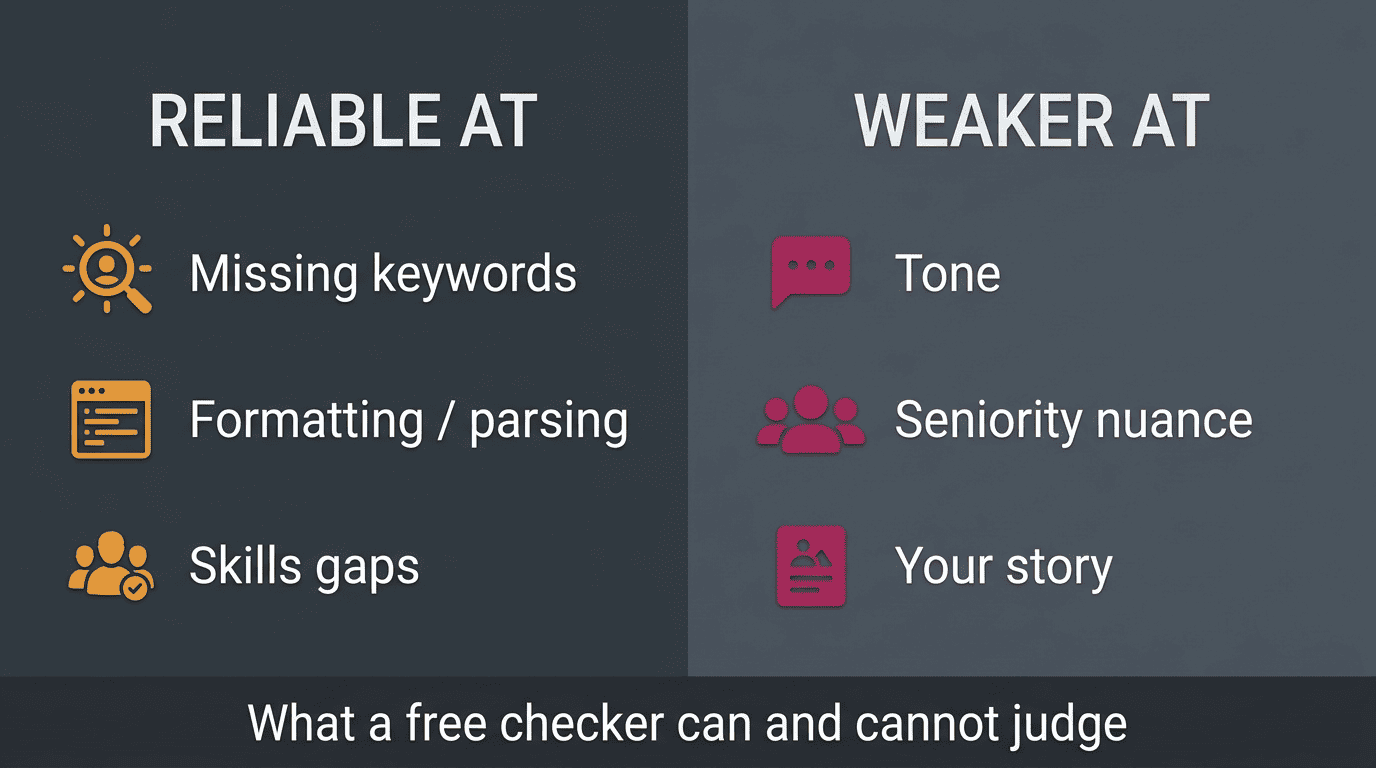
Free checkers are dependably good at the mechanical stuff, and weaker at the judgment calls a human recruiter makes. What they’re reliable at:
- Flagging missing keywords against a specific job description
- Catching skills gaps between the resume and the posting
- Spotting formatting that breaks ATS parsing
- Checking for consistent dates, headings and file structure
What they’re weaker at is tone, seniority nuance, and whether your story actually lands on the page. Because there’s no single, universal ATS scoring standard, the same resume can score differently across two free tools, so the smart move is to treat any AI resume checker score as a diagnostic, not a verdict.
A widely cited Harvard Business School study on hiring practices puts a number on this exact gap:
Nearly nine in ten (88%) of employers say that qualified high-skills candidates are being vetted out of the hiring process because their resumes don’t match the exact keywords and criteria in the job description, even though they could do the job.
Harvard Business School, «Hidden Workers: Untapped Talent»
That’s precisely the gap a free checker is built to close before a keyword mismatch ever costs you a shot. Still, a high score never guarantees an interview — it only improves the odds your resume reaches a human being instead of getting filtered out on the way.
Is it safe to upload your resume?
Your resume holds personal data — your name, contact details, employer history, sometimes your address — so privacy is a fair question before you upload anything. Many free checkers state they don’t store your resume and display results immediately without sharing your file with third parties, but that policy varies tool to tool, so it’s worth a glance at the privacy notice before you commit. The Federal Trade Commission recommends reading exactly what a service collects and how long it keeps it before uploading documents that contain personal information, and that guidance applies just as much to a resume-scanning tool as to any other web form.
There’s a separate honesty point worth raising too. A free AI resume checker is meant to sharpen a resume you actually wrote, not manufacture one from nothing — an estimated 49% of hiring managers say they’d reject a resume they believed was fully AI-generated, so the safest use of the tool is to fix and tighten your own work, not fabricate it.
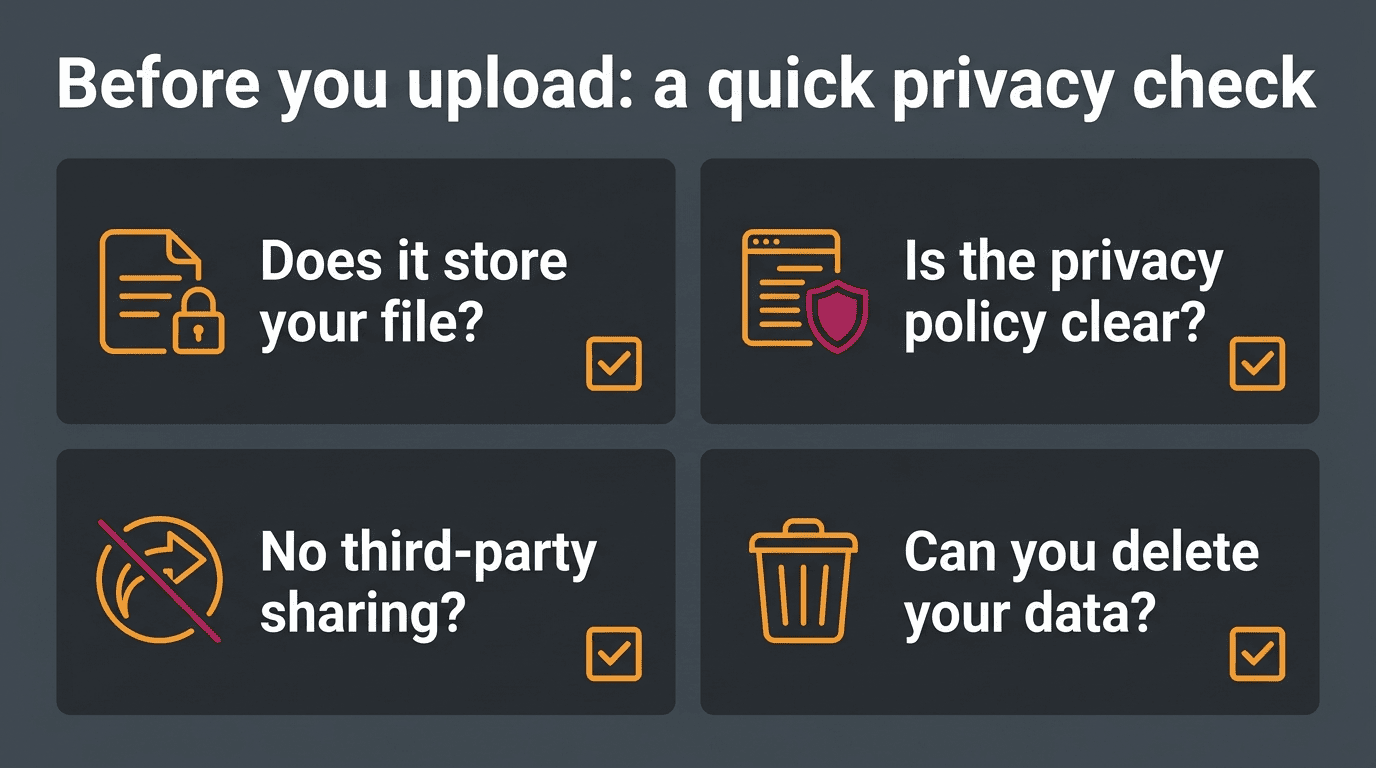
Before you upload, a quick privacy check is worth the extra minute:
- Does the tool state clearly whether it stores your resume file?
- Is the privacy policy easy to find and written in plain language?
- Does it say results are processed and shown without third-party sharing?
- Can you delete your data or account afterward if you want to?
How to use a free AI resume checker (step by step)
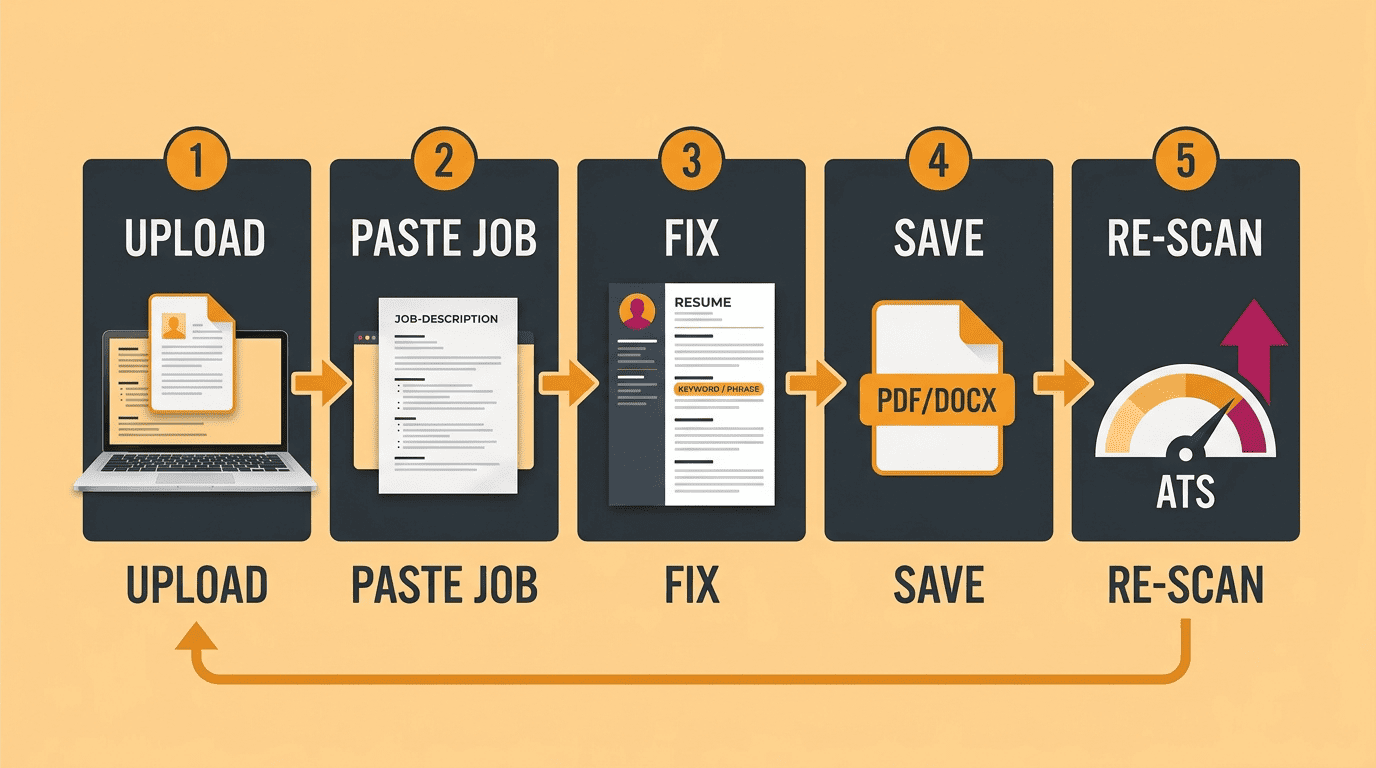
The workflow that gets the most out of a free tier is short and repeatable — most people can run through it in under five minutes:
- Upload your current resume and read the baseline score.
- Paste the exact job description so the tool can check keyword match, not just generic formatting.
- Fix the top-flagged issues — add missing hard-skill keywords in context, switch to a single-column layout, and use standard section headings the parser recognizes.
- Save the file as a text-based .docx or .pdf — never as an image or scanned file, since an ATS can’t read pixels.
- Re-scan and repeat until the weak sub-scores clear.
This check-fix-recheck loop is the whole point of a free tool — it costs nothing to run it as many times as your free tier allows, and each pass should nudge the score up.
How to choose a good free checker
Not all free checkers are equal, and the difference usually shows up in four places.
Job-description matching, not a generic score. A checker that only grades your resume in isolation misses the point — the score that matters is how well your resume matches the specific job posting you’re applying to, keyword for keyword.
The score visible without forced payment. If a tool hides the actual number behind a paywall and only shows you a teaser, it isn’t really a free checker — it’s a lead-generation funnel wearing a free badge.
A clear, readable privacy stance. Look for a plain statement about whether the resume is stored, for how long, and whether it’s shared — not a vague reference buried three clicks deep in a legal page.
Actionable fixes, not just a bare number. A score with no explanation tells you something is wrong without telling you what. When you want to check your resume with AI, a tool that shows you the exact keywords you’re missing beats one that only prints a percentage.
Job seekers have plenty of reason to lean on a tool like this: the U.S. Bureau of Labor Statistics tracks millions of job openings competing for attention every month, and a resume that clears the ATS filter cleanly is one less obstacle between you and an interview.