
AI Resume Checker ATS Score: What Your Number Means and How to Raise It
An AI resume checker reads your resume the way an Applicant Tracking System (ATS) does and returns an ATS score — a percentage that estimates how well your resume matches a job and how cleanly software can parse it. Most mid-size and large employers now run resumes through some form of the same Applicant Tracking System software before a human ever opens the file, which is exactly why that percentage matters. This guide explains how the score is calculated, what a «good» number looks like, and the fastest ways to lift it.
One caveat up front — an ATS score is a match rate, not a grade or a guarantee. There is no universal ATS scoring system, so different scanners score the same resume differently. Treat the number as a diagnostic, not a verdict, and remember that even a strong AI ATS resume checker score improves your odds of reaching a recruiter — it does not promise you the job.

How an AI resume checker turns your resume into an ATS score
An AI resume checker produces an ATS score by first simulating how a real applicant tracking system would ingest your file, and then comparing what it extracted against a target job posting. That comparison is where the number comes from. The category of software it simulates includes:
- Workday
- Greenhouse
- Lever
- Taleo
- iCIMS
What the checker actually does under the hood
An AI ATS resume checker simulates how real applicant tracking systems parse a resume, then compares the parsed text against a target job description. Modern checkers run a fixed battery of checks rather than a single pass: some tools run around 16 essential checks, others run 20 or more, and the more thorough ones run close to 27 checks spread across categories such as ATS essentials, section completeness, content quality, job tailoring, recruiter red flags, bias language and seniority signals. The AI checker’s job is to expose what that software would actually see, on both counts.
Parsability vs. content quality (the two tiers)
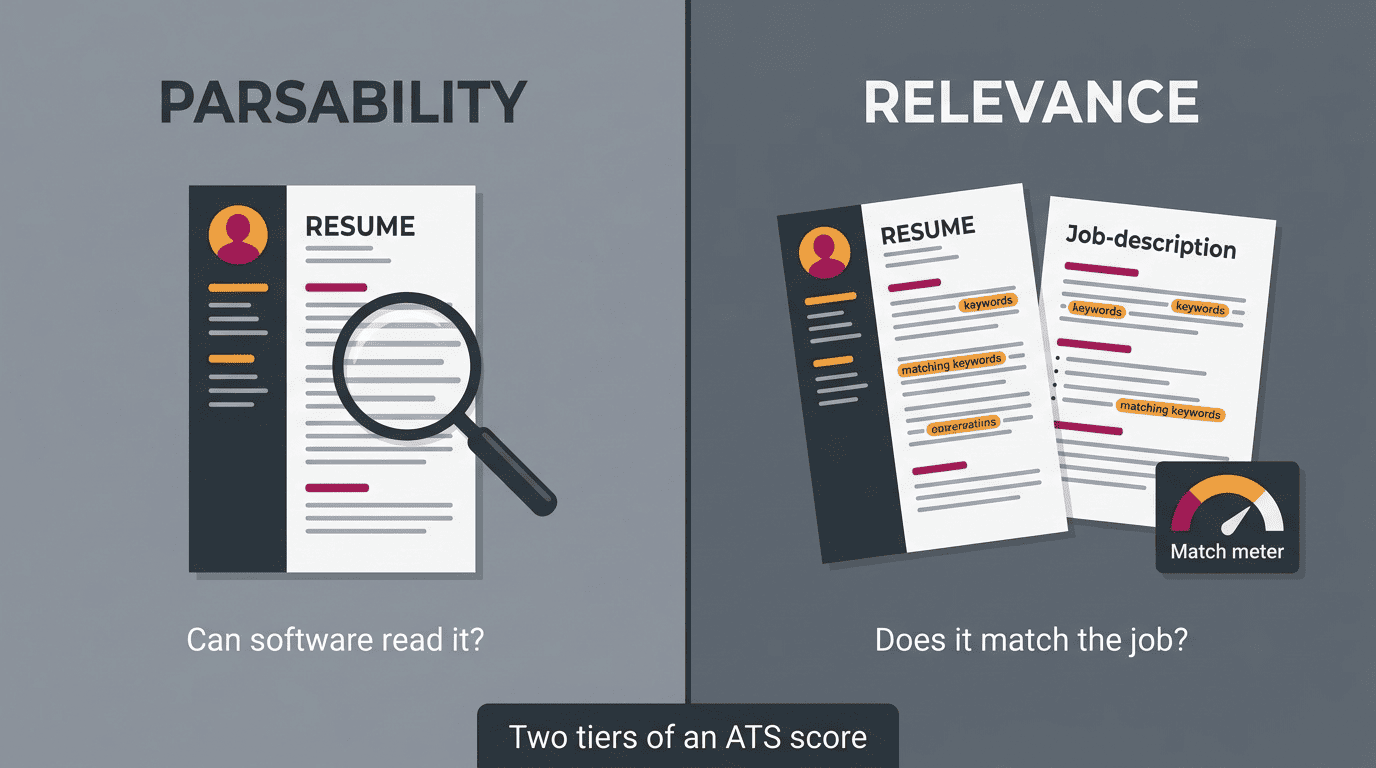
Most checkers score on two layers. First, a content-parsability rate: can the software cleanly read your name, sections, dates and skills? Common elements that break this layer include:
- Multi-column layouts
- Text boxes and tables
- Headers and footers that hold contact details
- Icons, graphics and photos standing in for text
Second, a quality-and-relevance layer: keyword overlap with the job, quantified achievements, and completeness. A resume can be perfectly readable and still score poorly if it never mentions the terms the job description uses, which is why parsability and relevance are graded separately rather than folded into one number.
How the ATS score is calculated: the weighting formula
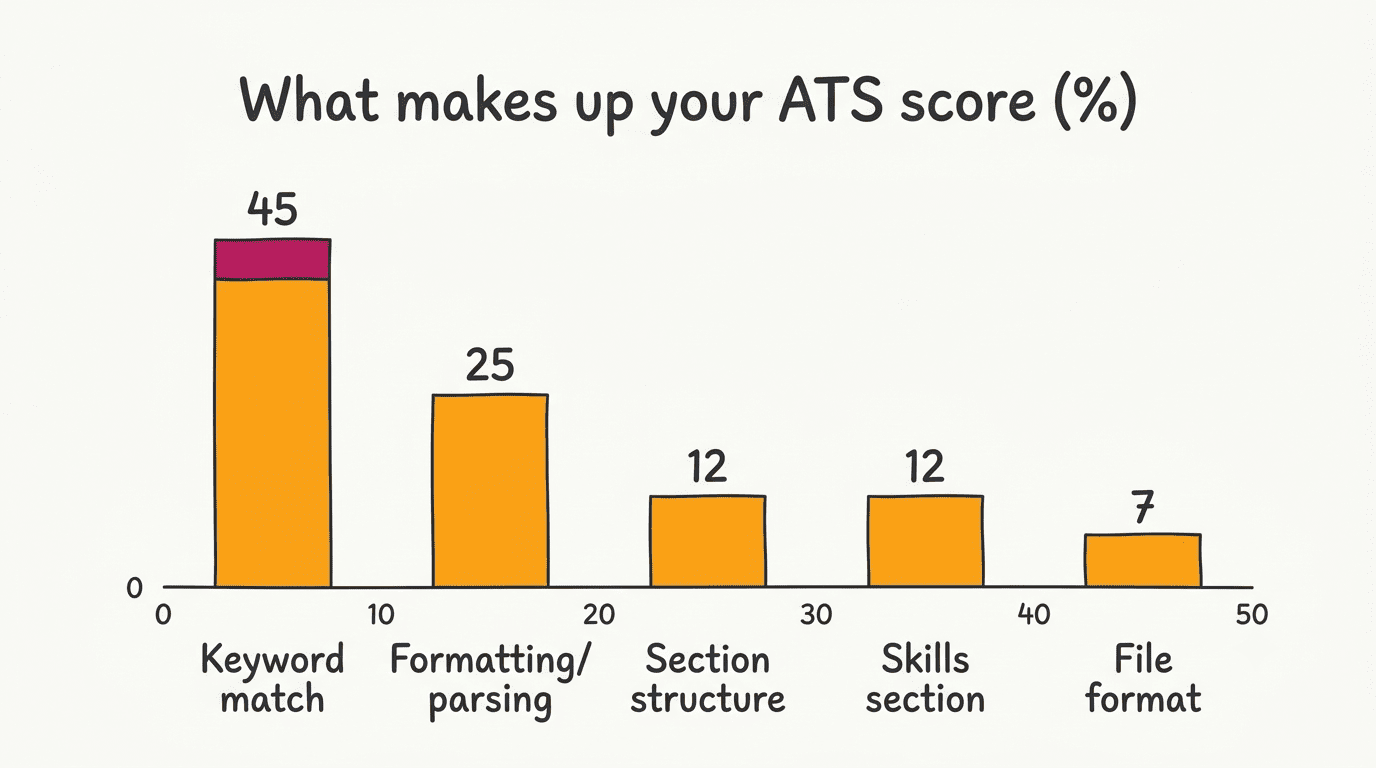
There is no single official formula published by any ATS vendor, but independent resume checkers converge on roughly the same weighting. The table below shows how the five main factors typically contribute to an ATS resume score / match rate.
| Factor | Typical weight | What it measures |
|---|---|---|
| Keyword match rate | 40–50% | Overlap between your resume’s language and the job description’s language |
| Formatting / parsing | 20–30% | Whether the layout (columns, tables, headers) lets software extract clean text |
| Section structure | 10–15% | Presence and order of standard sections (experience, education, skills) |
| Skills-section optimization | 10–15% | Hard and soft skills listed in a dedicated, scannable section |
| File format | 5–10% | Whether the file is a text-based .docx or .pdf rather than a scanned image |
The five weighted factors
Keyword match rate is the single biggest factor, running 40–50% of the score in most checkers. Formatting and parsing follow at 20–30% — a two-column PDF that scans as gibberish to the parser can tank this sub-score even if the content is strong. Section structure and skills-section optimization each account for roughly 10–15%, and file format contributes the remaining 5–10%. Together these five factors are what an AI resume checker is actually measuring when it hands back a single percentage.
Why keywords dominate
Because the system compares your resume against the exact language of the job description, keyword alignment is the lever that moves the score most. There’s a trap here worth naming: keyword stuffing can inflate a proxy score but reads as spam to a human reviewer, and newer semantic matchers are increasingly able to catch it. Signs a resume has crossed into stuffing rather than honest tailoring:
- The same skill phrase repeated three or more times in different sections
- A wall of keywords with no sentence structure around them
- Skills listed that never appear anywhere in the work-experience bullets
- White or invisible text hiding extra keywords from human readers
The sustainable approach is to mirror the job description’s real terminology honestly, not to pad the page with repeated buzzwords.
What is a good ATS score? Score bands explained
Score bands give the raw number context. An ATS simulation exists to help a candidate understand whether a resume will pass through the software recruiters use before a human ever reads it, and the bands below are how most checkers translate that pass/fail logic into a percentage.
The bands: 50, 70, 80, 90+
Here’s how the ranges typically break down: 0–50 is poor and likely filtered before a human sees the resume, 50–70 needs improvement, 70–85 is good and passes most filters, and 85–100 is excellent. As practical targets, 70+ counts as a good ATS score, 80+ is competitive, and 85–95 is the realistic optimum for most job seekers. Most employer cutoffs sit between 55 and 70, so clearing 70 already moves a resume out of the automatic-rejection zone for the majority of postings.
| Score range | Label | What it means |
|---|---|---|
| 0–50 | Poor | Likely filtered out before a human review |
| 50–70 | Needs work | Below most employer cutoffs; targeted edits needed |
| 70–85 | Good | Passes most ATS filters |
| 85–100 | Excellent | Near the practical ceiling |
Why the same resume gets different scores
Different scanners weight factors differently, and because there is no universal ATS scoring standard, the same resume can score 72 on one tool and 85 on another. That’s not a bug — it’s a reason to use the number to find weaknesses rather than to chase a perfect 100. A resume checker online is most useful the second and third time you run it, once you can watch a specific sub-score move after an edit.
How to improve your ATS score with an AI resume checker
Raising an ATS score is mostly a checklist problem, and small, targeted edits typically add 15–25 points once you know which sub-score is weak.
A step-by-step checklist
- Paste the exact job description into the AI ATS resume checker and mirror its hard-skill keywords naturally, in context, rather than as a dumped list.
- Use a single-column layout and standard section headings (Experience, Education, Skills) so the parser reads the file cleanly.
- Save as the requested file format — a text-based .docx or .pdf, never a scanned image or a designed graphic.
- Quantify achievements with real numbers instead of vague responsibility statements.
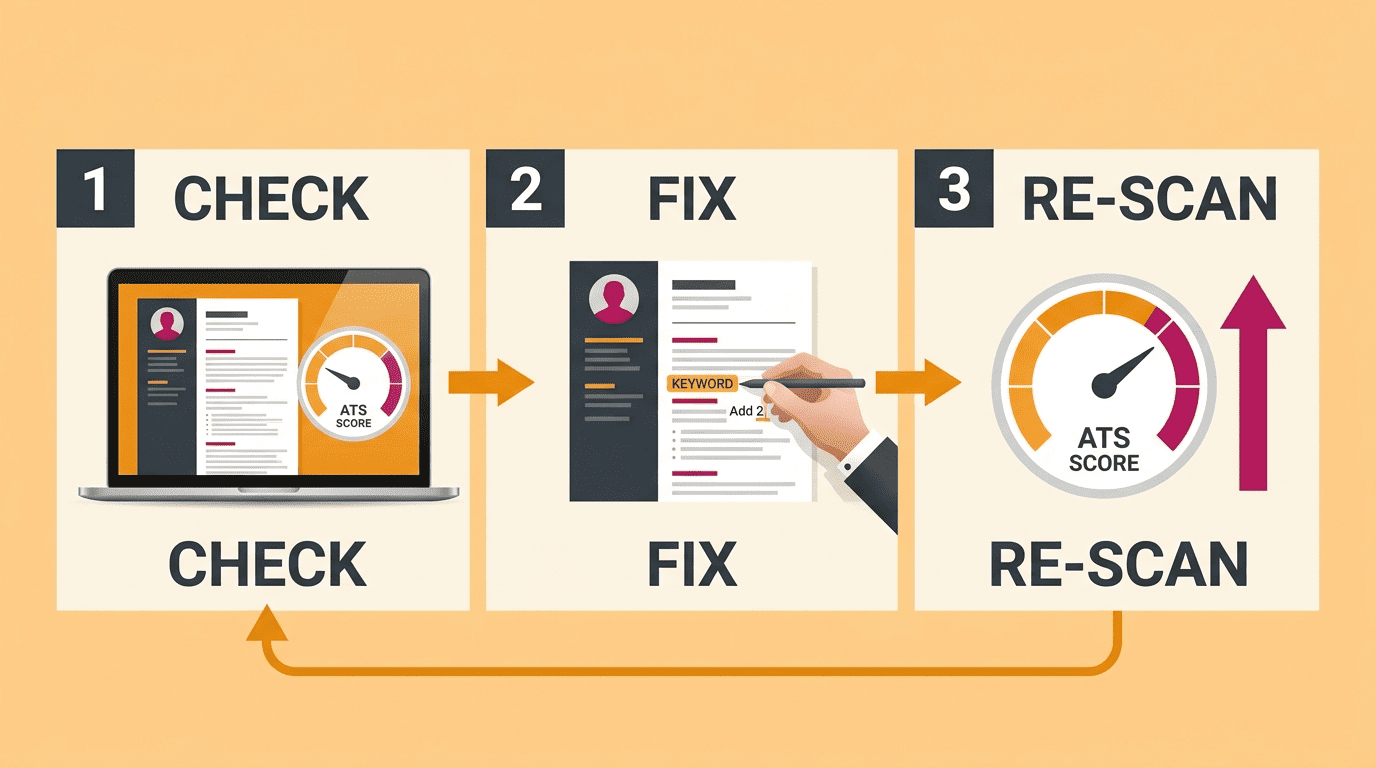
- Re-scan after each edit and watch which sub-score moves, then repeat the loop until the weak sub-score clears the target range.
This check-fix-recheck loop is exactly what an AI resume checker is built for: it turns a vague «improve your resume» instruction into a measurable, repeatable process.
Tailor per job, don’t mass-apply
The average job posting draws 250 or more applicants competing over a national pool of job openings that shifts every month, and an estimated 98–99% of Fortune 500 companies filter incoming resumes with some form of ATS before a recruiter looks at them. Given that volume, a resume tuned to each specific job description with a resume checker online consistently out-scores a single generic version sent to every posting.
The limits: what an ATS score does not tell you
An applicant tracking system (ATS) is a software application that enables the electronic handling of recruitment and hiring processes.
Wikipedia, Applicant tracking system
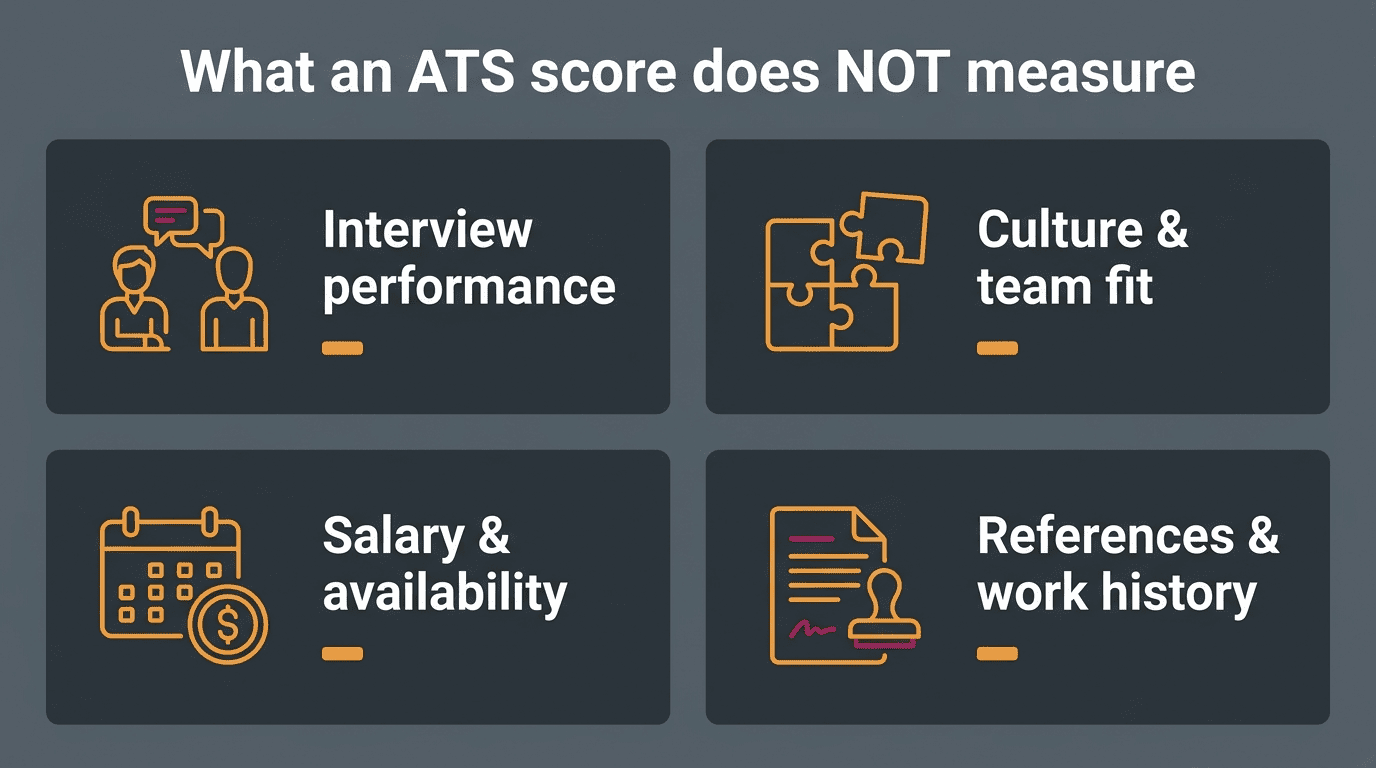
A high ATS score means your resume is more likely to reach a recruiter — it does not mean you’ll get the interview. Job fit, real experience and how you present yourself in an interview still decide the outcome. An ATS score does not measure:
- How well you’ll perform in the interview itself
- Culture and team fit
- Salary expectations or availability
- References and verified work history
It’s also worth knowing that a significant share of hiring managers say they would reject a resume they believed was AI-generated wholesale, so the safer approach is to use AI to sharpen a genuinely human resume rather than to fabricate one from scratch.
This is where the mismatch between «score» and «outcome» matters most. An ATS score of 90 is still just a match rate, not a promise, and no AI resume checker — including a well-tuned one — can guarantee that a specific application turns into a job offer. Used honestly, it’s a diagnostic that improves your odds by catching parsing errors and keyword gaps you can’t see on your own; the interview and the hire still come down to fit, experience and how you show up once you’re in front of a person.